A Hammock of Cheese and Two Cavities: How a Storybook Gave Us a Language for the Hard Stuff
What happened when the book I built met real life in a dentist’s chair.
This morning I took my 6-year-old to get two cavities filled.
I want to tell you about it, not because it was a great morning (it wasn’t), but because twenty minutes after the drilling stopped, my kid did something that made me think: this is why I built this thing.
The morning
If you’ve ever taken a young child to get a cavity filled, you know the drill. Pun intended, unfortunately.
There’s the waiting room, where everything is fine and there are stickers and a fish tank and your kid is brave and you’re brave and everyone is very, very brave. Then there’s the chair, the bib, the syringe, and the sound. That high, whirring sound that no amount of parental cheerfulness can make okay.
My son was scared. He was brave about being scared, which is almost worse to watch, because you can see them holding it together and you know what that’s costing them. The numbing shot happened. The drilling happened. He gripped my hand. I gripped back.
It was fine. It’s always fine. But “fine” and “easy” are not the same thing, and anyone who tells you kids bounce right back from dental work has not recently looked into the eyes of a 6-year-old with a numb lip and a betrayed expression. And I should name what I was feeling in that chair, because “it was hard” is a dodge: it was guilt. Cavities in a 6-year-old feel like a report card on the parent, and I did not get an A.
The grass patch
Afterward, we sat on the grass outside the dentist’s office. This is where the real appointment happened.
He was working through it all: the numb mouth, the weird sensation of not being able to feel his own smile, the drool drooping, the residual anxiety of machines that make sounds no human should have to hear before 11am. I let him sit with it. We didn’t rush.
And then we talked. Not about feelings in the abstract, not about “being brave” (he’d been brave enough for one day). We talked about teeth. Specifically, we talked about Tooth Town.
It worked for one reason: we had the same language.
The book that showed up at exactly the right time
A week ago, just one week, I printed a copy of The Bravest Mouth in Town. It’s a story I built on Enchantably, and I won’t pretend to be objective about it. I’m proud of this book in a way that catches me off guard every time I flip through it.
It’s a story about two boys, my boys, Ander and Alden, who get pulled through their bathroom sink into Tooth Town, a magical village where every building is shaped like a tooth and the residents are... teeth. With personalities. The Front Teeth are show-offs. The Canines wear tiny black capes. And the Molars? The Molars sit in the back, in the dark, feeling skipped and forgotten because nobody’s brush ever reaches them.
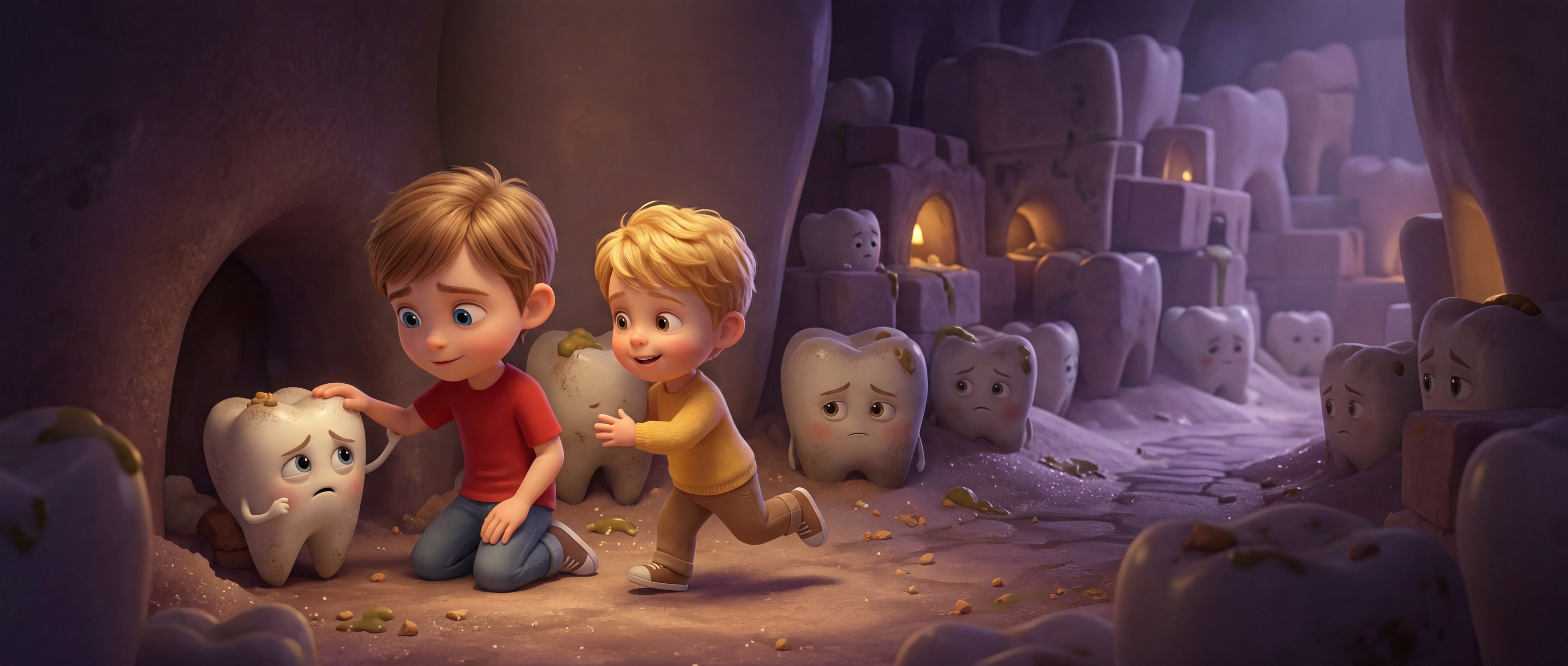
There’s a Gunk army: sticky green monsters who build forts out of sugar cubes and hammocks out of plaque. There’s a moment where the boys scrub too hard and the teeth hold up scorecards that say “Negative Two!” There’s a legendary hero named the Floss who ziplines in wearing goggles to save the day. And there’s a comic beat where a green Gunk monster gets launched off a hammock of cheese that makes my 4-year-old laugh so hard he falls sideways.
The story teaches brushing technique (gentle circles, not too rough, reaching the back teeth, using floss for the spaces between), but it does it inside an adventure. The lessons are sewn into the plot so tightly that a child absorbs them the way they absorb any story: by living inside it.
We’ve read it just twice over the past week.
The chuckle on the way home
So there we were. Grass patch. Post-cavity feelings. And because we’ve read a book a few times, we had a shared vocabulary that no dental hygiene pamphlet could have given us.
We talked about the Molars. “Those are the ones that got the cavities,” I told him. “The ones in the back that feel skipped.” He nodded. He knew exactly which characters I meant. He’d felt sorry for them in the story, the ones sitting in the dark, saying “we get skipped.”
We made a plan. We talked about brushing the back teeth, the inside and the outside, gentle circles like the front tooth explained in the story. Not too rough (the “Negative Two!” scorecards), not too fast, all the way to the back where the Molars live. We talked about the Floss, the hero who gets into the tight spaces the brush can’t reach.
We devised a real, concrete, kid-led plan for prevention. Not because I lectured him. Because we’d both been to Tooth Town, and we both knew what was at stake for those little guys back there.
On the drive home he was quiet. Numb lip, leftover dread, the kind of silence I have learned not to poke at.
And then he chuckled. Out loud. To himself.
I looked in the rearview mirror. “What was that about?”
He grinned, lopsided because half his mouth was still asleep, and said:
“A hammock of cheese! He launched off it!”
And then he giggled. That uncontrollable, delightful, full-body giggle that only a kid who has completely forgotten he was upset twenty minutes ago can produce.
He was replaying the book in his head. Not the dental lesson or the brushing technique: the funny part. The part that made the whole story stick, because it delighted him, and delight is the glue that holds everything else in place.
A giggle from the booster seat is not a controlled study. It is, however, the entire thesis of my company, so I’m counting it.
What the book didn’t do (and that’s okay)
I want to be clear: The Bravest Mouth in Town did not prevent two cavities. We’d only had it a week. The cavities were already there, doing their thing, long before Tooth Town existed in our house.
What it did do is quieter, and I think more useful.
It gave us a language. When I said “the Molars in the back,” he didn’t hear a dental anatomy lesson. He heard characters he cared about. When I said “gentle circles,” he didn’t hear a hygiene instruction. He heard what the front tooth taught the boys to do. When I said “floss gets in the tight spaces,” he didn’t hear a chore. He heard the zipline hero.
The book turned prevention from something I was telling him to do into something we were figuring out together, using a world we’d both visited. That’s not a small difference. That’s the difference between a kid who tunes out and a kid who builds a plan with you.
And the giggle on the way home, the hammock of cheese surfacing unprompted through the residue of a hard morning? That’s my proof that the story didn’t just pass through him. It moved into his imagination and set up housekeeping, apparently right next door to the cheese.
Mama is proud. Of him, for being braver than he needed to be. And of this little book that showed up just in time.
The Bravest Mouth is available for your kid, too
This story, the one I read to Ander and Alden, is fully customizable on Enchantably under Quick Magic. Any parent can drop their child’s name, their sibling or friend, their details into the same arc, and the AI will generate a completely unique version of the adventure for their family. Same Tooth Town. Same Gunk army. Same legendary Floss. But it’s their kids scrubbing the Molars and laughing at the cheese hammock.
If you have a dental visit coming up, or if you’re just trying to make brushing feel like less of a nightly negotiation, this is the one. I can’t promise it’ll prevent cavities. But I can promise it’ll give you and your kid a shared world to talk about teeth in, and that’s worth more than any pamphlet.
Okay but real talk: vitamin gummies
I need to have an honest moment with you about something, and I genuinely want your opinion.
Every dentist alive will tell you to avoid gummy vitamins for kids. Twelve out of ten dentists. They stick to teeth. They’re basically sugar dressed up in a lab coat. From a dental health perspective, they’re the Gunk army in vitamin form.
I know this. I hear it at every checkup.
I also know that I have personally tried five non-gummy kids’ vitamins, and every single one was rejected with the kind of theatrical disgust that only a child can produce. The chewable tablets. The liquid drops. The powder you’re supposed to mix into a smoothie (he tasted it, looked at me like I’d betrayed him, and dumped the smoothie in the sink).
Gummy vitamins are the one my kids will actually take. Every single day, without a fight. And in a household where every morning is a negotiation (shoes, breakfast, backpack, teeth, out the door), “without a fight” is not a trivial feature.
So I’m asking, and I don’t have the answer: where do you land on this? Do you hold the dental line and fight the vitamin battle? Do you give the gummies and accept the tradeoff? Have you found the mythical non-gummy vitamin that a kid actually likes?
I’m asking because I’m considering whether to include gummy vitamins as something to watch out for in future health story arcs. But this one isn’t clear-cut to me. The science says one thing. The reality of parenting at 7:15am says another. And I think the honest answer lives somewhere in between.
Ready to Create Something Magical?
Discover personalized storybooks starring your child's favorite toy, pet, or loved one.
Explore the Magic TodayJoin the Conversation
Where do you land on the gummy vitamins question? Do you hold the dental line and fight the vitamin battle? Do you give the gummies and accept the tradeoff? Have you found the mythical non-gummy vitamin that a kid actually likes? I genuinely want to know.