
How I Decide Which Stories to Build (It Usually Starts with Dirty Hands)
The surprisingly unglamorous origin story behind every Enchantably template.
People sometimes ask how I choose which stories to add to Enchantably, and I can hear the answer they’re expecting: a process. Market research, keyword analysis, maybe a spreadsheet ranking educational outcomes against engagement metrics.
The real answer is that last Tuesday my 4-year-old came home from school, walked directly past the bathroom, wiped his hands on the couch, and announced he was hungry. Other companies have a research department. I have a couch.
That’s a story.
Every template starts with a kid I know doing something very real
The story arcs on Enchantably, the ones in Quick Magic and Safety Magic that are ready for you to drop your child’s characters into and go, didn’t come from a brainstorming session. They came from my living room, my backyard, and the car ride home from school when everyone is cranky and tired and somebody is crying about something that makes no sense to an adult but is clearly the end of the world.
My boys are 4 and 6. Their friends cycle through our house on weekends. I am surrounded, at all times, by extremely raw data on what kids are actually dealing with.
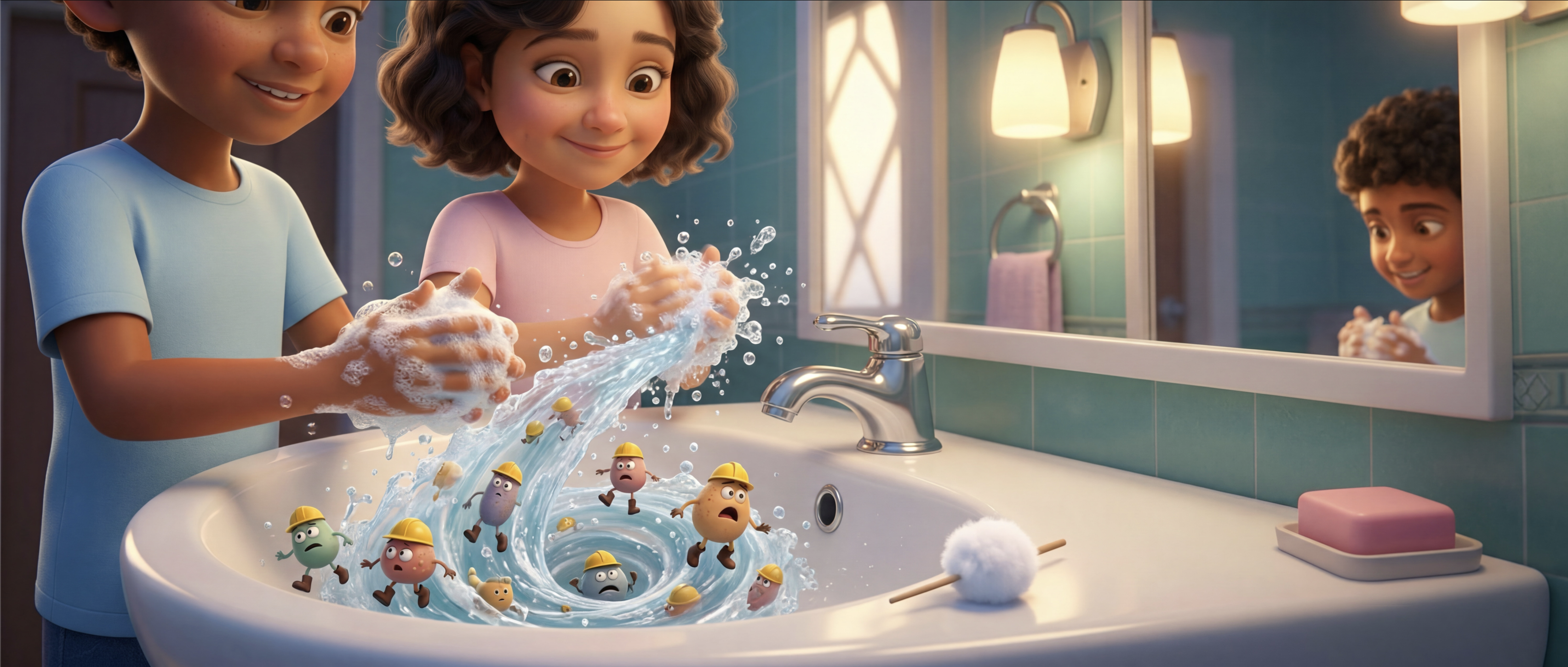
The hand-washing story happened because I watched my son, and every other kid who walks through our door, treat the sink like an optional suggestion. And I thought: what if there was a story where washing your hands was the thing that activated your superpower? Not a lecture. Not a hygiene poster. An adventure where the moment you scrub your hands, something magical happens, and the kid just... wants to do it. Because in the story, it mattered. And the story was about them.
That’s how it always starts. I see something, I feel something, and then I build a story arc around it: a blueprint that the AI will use to generate a unique, personalized story for someone else’s kid going through the exact same thing.
The space kid. The kid who has to win. The kid who can’t find the words.
My oldest is obsessed with space. Not in a cute, passing way; in a please stop telling me about black holes at dinner way. He wants to travel to other galaxies. He wants to know what’s past the edge of the universe. He would live on a rocket if we let him.
So of course there’s a space arc. But it’s not just “kid goes to space.” It’s an arc where the journey itself teaches something: the discovery matters more than the destination, and getting lost is part of the adventure, not a failure. And when a parent picks that arc and drops their child in, the AI builds a story around their kid, with their name, their companion, and their own version of the cosmos. Every story is different. But the emotional architecture underneath is the same, and I built it on purpose.
The other thing about my oldest: he wants to win. At everything. Board games, races to the car, who gets to push the elevator button. And when he doesn’t win, the world collapses. He’s not unusual in this; most kids his age are wired the same way. But it means the arcs I build for that age aren’t just about the adventure. They’re about what happens when the adventure doesn’t go the way you planned. When the dragon doesn’t get defeated. When the treasure isn’t where the map said it would be. When the real reward turns out to be the weird little thing you noticed on the way.
I think a lot about how to build an arc where the “aha!” moment isn’t I won, but oh, that’s what mattered all along. That’s hard to design; it takes ten drafts to get right. But when it lands, when a child reads a story generated from that arc and absorbs the lesson without even knowing it was a lesson, they learn something a conversation couldn’t have taught them. They learn it from inside a story, which is the only place certain lessons actually stick.
What ten drafts actually looks like
I want to pull back the curtain on this, because I think people imagine I type a prompt, something comes out, and I hit publish. I wish.
The first thing to understand is that I’m not writing your child’s story. I’m building the arc. The blueprint: the emotional architecture that the AI then uses to generate a completely one-of-a-kind story for your kid, featuring their name, their favorite things, and their world. No two books that come out of the same arc are alike. But every one of them runs on the same carefully built bones.
So what goes into those bones? I start with the emotional core: the real-life moment, the thing I want a child to feel differently about after reading this story. Then I build the arc, a beginning that hooks, a middle that moves, an ending that surprises. And then I refine it. At least ten times. Usually more.
I think through locations, not just “a forest” or “a castle,” but which forest, which castle, and what does that setting make the child feel? I think through the personalization prompts, the places where a parent drops in their child’s name, their favorite toy, the details that transform this arc into their story. I think about the “aha!” moment: is it earned? Is it unpredictable? Will a kid see it coming or will their eyes get wide? I think about comic relief, because children need to laugh in the middle of a story, and the laugh has to feel natural, not forced. I think about emotional pacing: is there just the right amount of tension? Does it rise and fall in a way that feels like breathing?
I create the arc. I test it by generating story after story from it and reading them out loud, sometimes to my kids, sometimes to myself. I watch what works. I notice where the energy dips, where the surprise falls flat, where the emotional turn feels forced. I go back into the arc and reshape it. Then I generate again. And again.
Sometimes I’ll rework a single beat in the arc seven times because the stories it produces keep landing slightly off. Sometimes I’ll throw out an entire ending structure because the stories are satisfying but not surprising, because I’ve learned that kids don’t need satisfying. They need surprising. They need to turn the page and think I didn’t know that was going to happen.
This is the process. It is not efficient and it does not scale. It’s a person sitting at a table, obsessing over whether the arc she’s built will make a four-year-old gasp at page six, not in one story, but in every story that arc creates.
I love it more than anything I’ve ever done professionally.
The stories I wish I’d built sooner
This part comes with regret. My boys are 4 and 6 now. They’re verbal, opinionated, full of personality. But I didn’t start Enchantably until a year ago, which means I missed the window I think about most, the toddler years. Ages 2 and 3 are the era of first emotions that don’t have names yet: the frustration of wanting something and not having the words, the rage of being small in a world that isn’t designed for you, the overwhelming, consuming sadness of dropping an ice cream cone.
I wish I’d had these arcs then. An arc where a character who looks like my kid feels a big, scary feeling and discovers, not through a lesson but through the adventure, that the feeling has a name, and the name makes it less scary. Every parent going through that phase could have generated a story tailored to their child, their moment, their exact flavor of toddler heartbreak. That would have changed some very hard afternoons.
Where this is heading
More templates are coming. A lot more. And as my boys grow, the stories will grow with them.
Right now, the arcs are built for the world my kids live in: hand-washing, sharing, fear of the dark, the overwhelming need to be first. But I’m already thinking about what comes next. Arcs for 7 and 8-year-olds navigating friendships that suddenly have politics, for 9 and 10-year-olds who are starting to compare themselves to everyone, for early teens who are grappling with the hard stuff: identity, belonging, the ache of wanting to be understood.
I’ll rotate through themes to keep it fresh. Some arcs will cycle out and come back. Some will be seasonal. Some will exist because one specific kid I know is going through one specific thing, and I’ll think there should be an arc for that, and then there will be.
That’s the whole strategy: watch kids, feel things, build arcs, and refine them until every story they generate is right.
It’s not complicated. It’s just deeply personal. And somewhere in my living room, my head of research is wiping his hands on the couch again, already hard at work on next year’s roadmap.
Ready to Create Something Magical?
Discover personalized storybooks starring your child's favorite toy, pet, or loved one.
Explore the Magic TodayJoin the Conversation
What stories do you wish existed for your kid? What’s the moment — the bedtime battle, the school-morning meltdown, the fear they can’t quite explain — that you’d want a story to meet them in? Tell me. These are the stories I’ll build next.