
My Husband in Every Century
I made two love stories set in Pompeii and Venice starring my husband and me, and I am not even a little bit sorry.
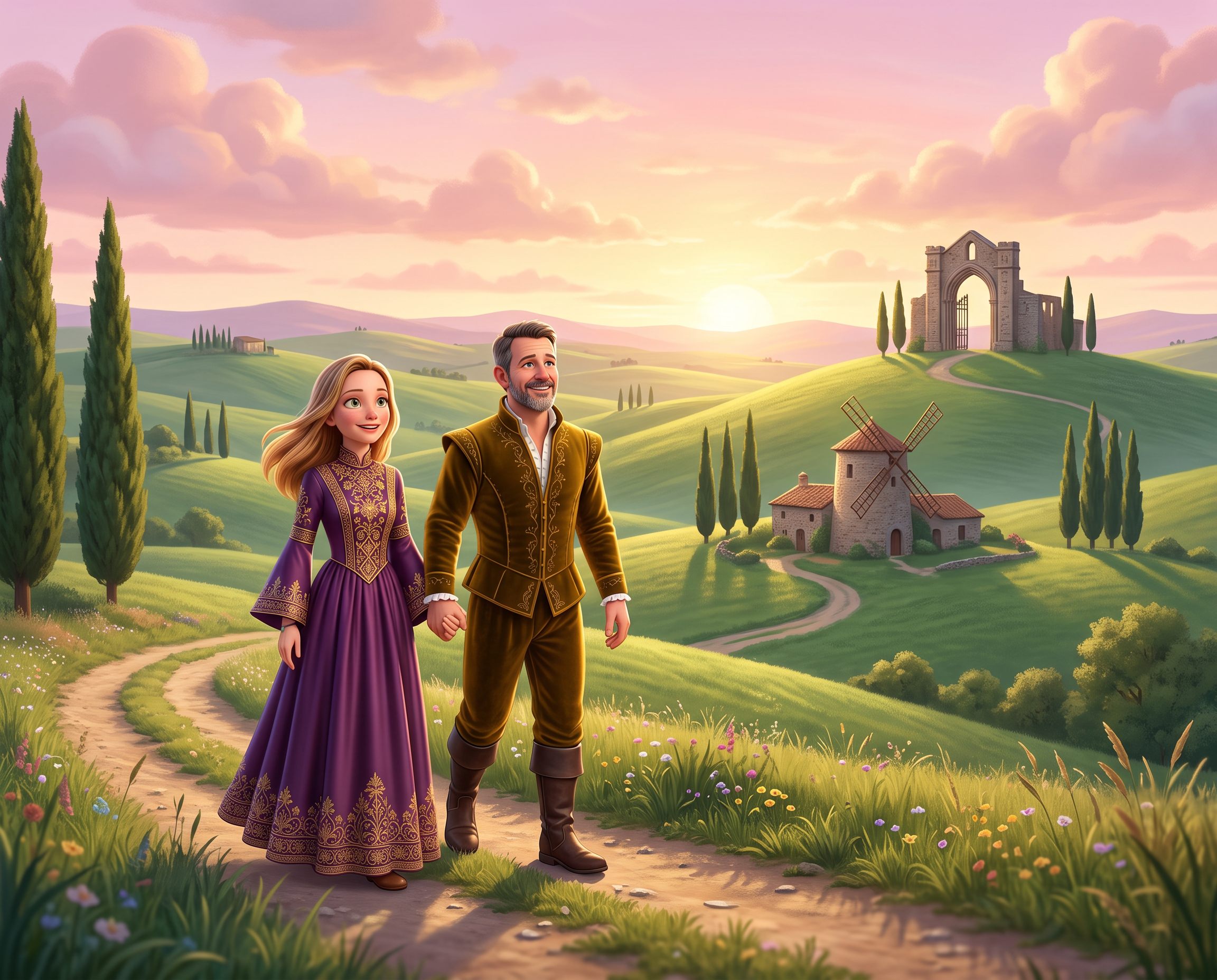
This post is not about parenting. This post is not about pedagogy or prosody or safety scenarios or any of the things I usually write about. This post is about me making two storybooks where my husband and I fall in love in ancient Pompeii and Renaissance Venice, and how I can’t stop looking at them.
This is the fun one.
How it started
It started the way most of my best ideas start: at 10pm, with no plan. I was testing some illustration prompts and I thought: what would it look like if I set a story in Pompeii? Not a kids’ story. A love story. My love story. Except in 33 AD, in a sunlit courtyard below Vesuvius, with Ryan in a linen tunic and me in a green stola.
I wanted to see if the magic could do something it wasn’t designed for. Could it render ancient Rome? Could it paint frescoes on the walls? Could it make my husband look like my husband, but in sandals, mixing mortar?
It could.
Pompeii, 33 AD
The first story is called Ana, Ryan and the Garden Wall Mural. The premise is simple: we live in a courtyard in Pompeii. An ancient wall is crumbling. Ryan shows up with tools and a crafting book. We fix the wall together, paint a massive mural of the Neapolitan coast onto it, and then walk through the vineyards on Vesuvius eating figs as the sun goes down.
There’s also a ginger cat who jumps into a mortar bucket and splatters Ryan’s nose, because even in ancient Rome, cats are agents of chaos.
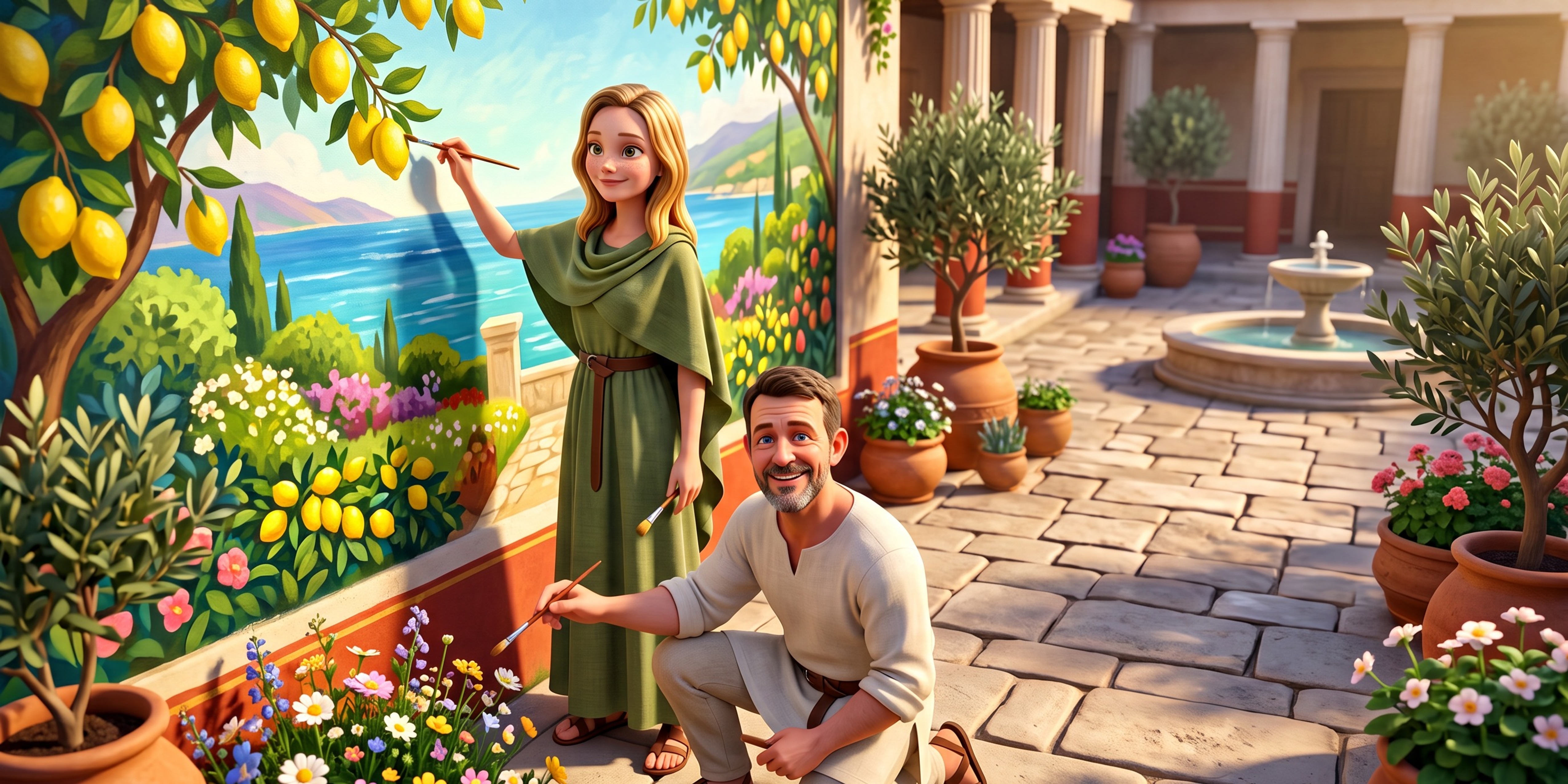
Look at that mural. Look at the light. Look at the way the blue of the painted sea sits against the actual Neapolitan sky behind the wall. This is an AI-generated illustration of a fictional ancient mural in a fictional Pompeii courtyard, and it is one of the most beautiful things I’ve made on this platform.
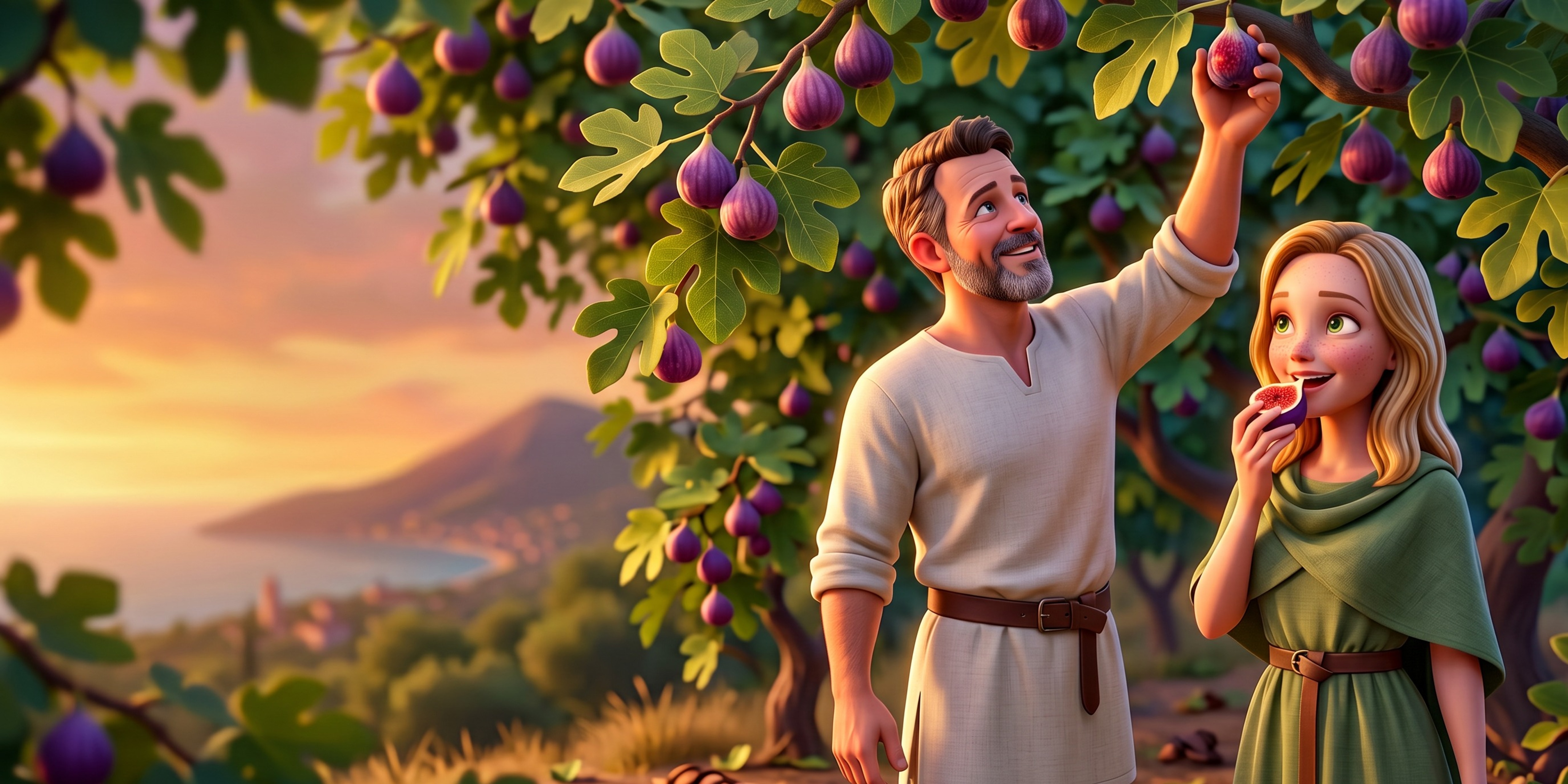
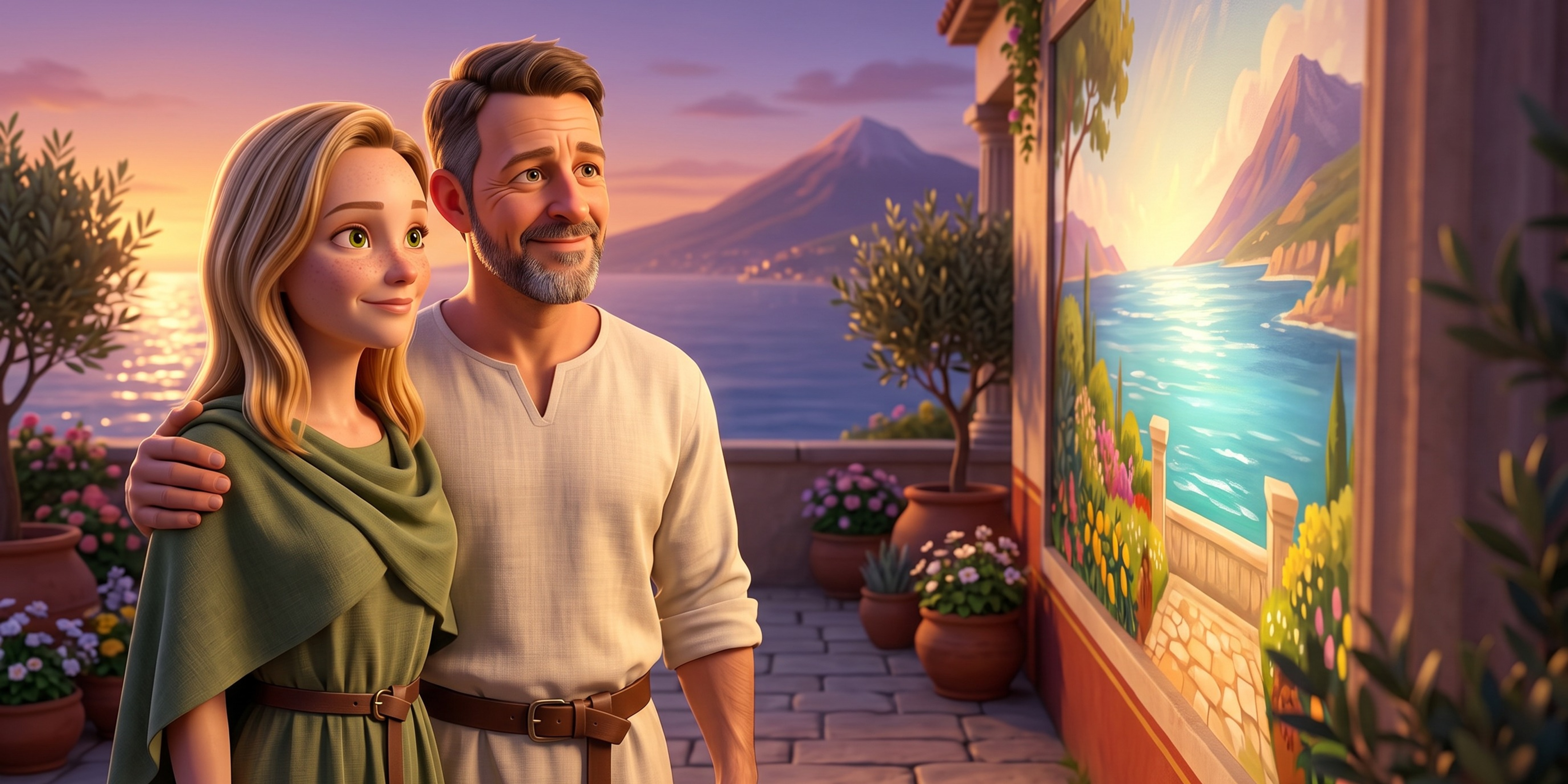
The verse that got me:
As twilight painted mountain height, the courtyard filled with golden light. The painted sea began to glow, beside the real waves down below. Their hands had worked as one all day, to chase the darker shades away.
Reader, I made myself cry with my own Pompeii fanfiction about my own marriage. This is where we are now. I’m not apologizing for it.
Venice, 1520
The second story is called The Emerald String of Venice, and if the Pompeii book was warm and domestic, this one is straight-up romance.
Venice. Masquerade ball. I’m wearing a silk dress with an emerald string stitched into it for luck. Ryan is in the crowd in a golden mask, searching for someone “both brave and true.” I trip on a marble staircase above the Grand Canal — because of course I do — and he catches me. The emerald string starts to glow. A ridiculous fat bird drops a flower on my mask.
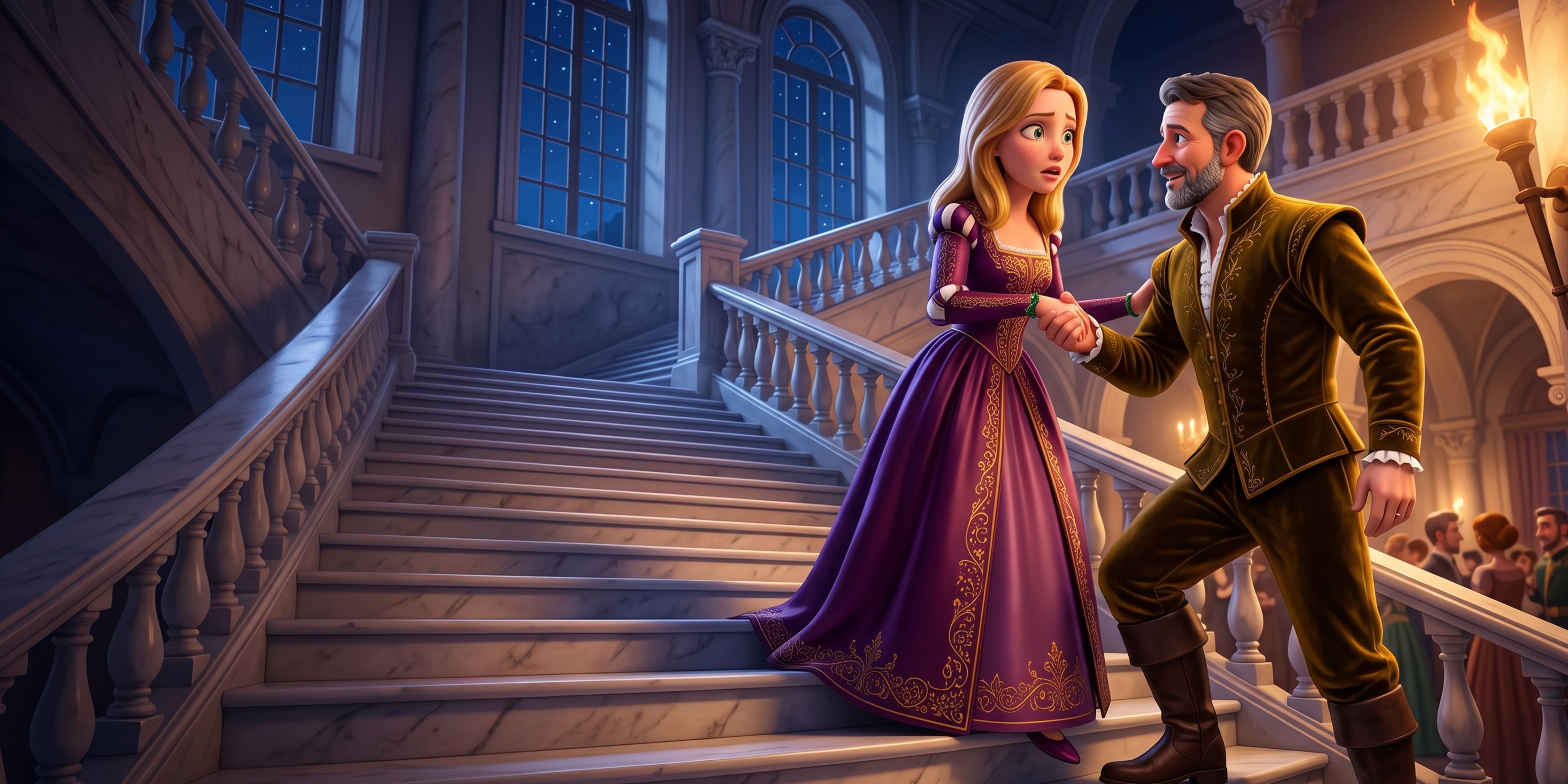
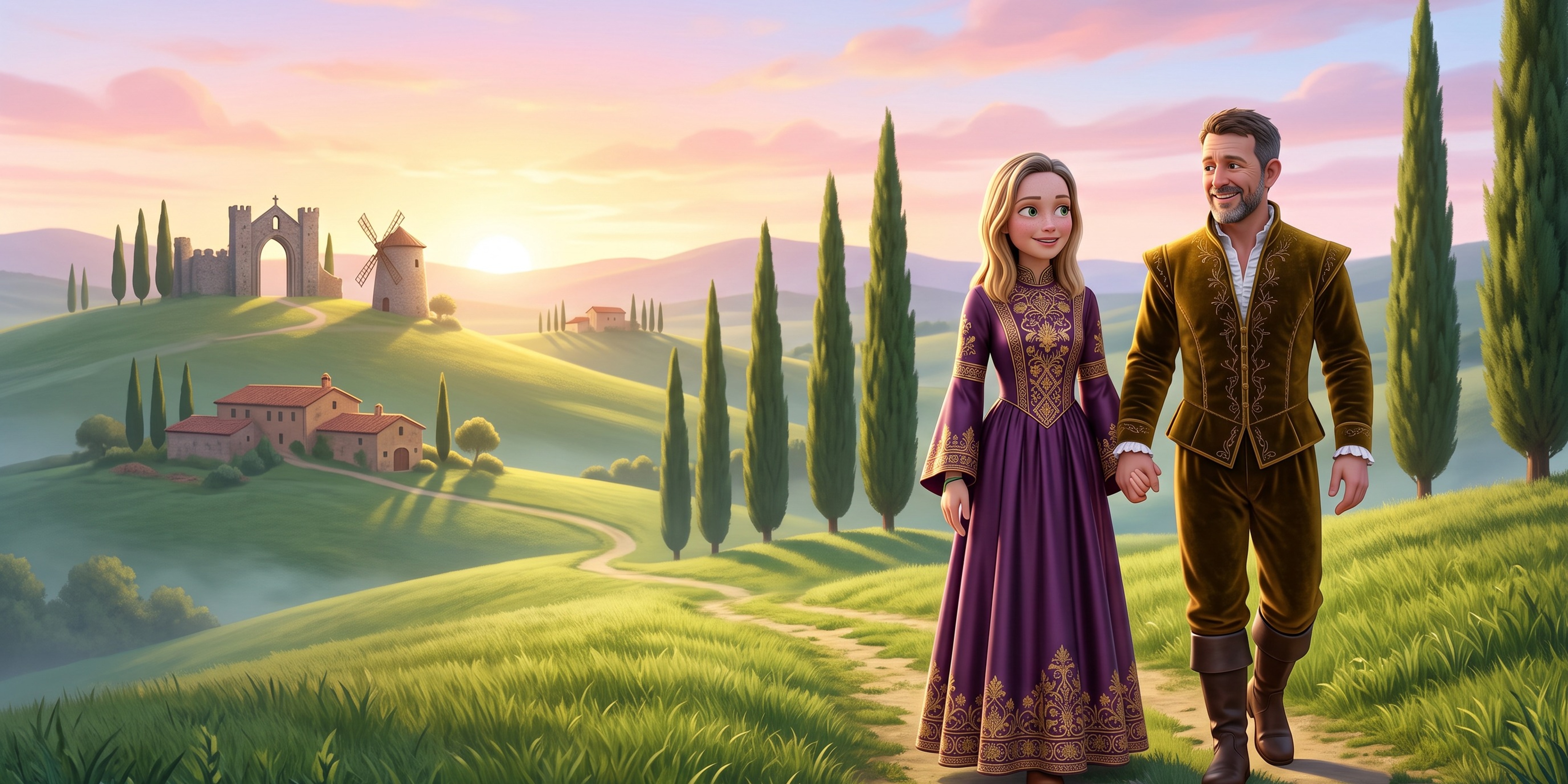
Then we take a gondola under the Rialto, find an ancient library with a map to the Tuscan hills, and end up drinking wine at sunset in an abbey courtyard.
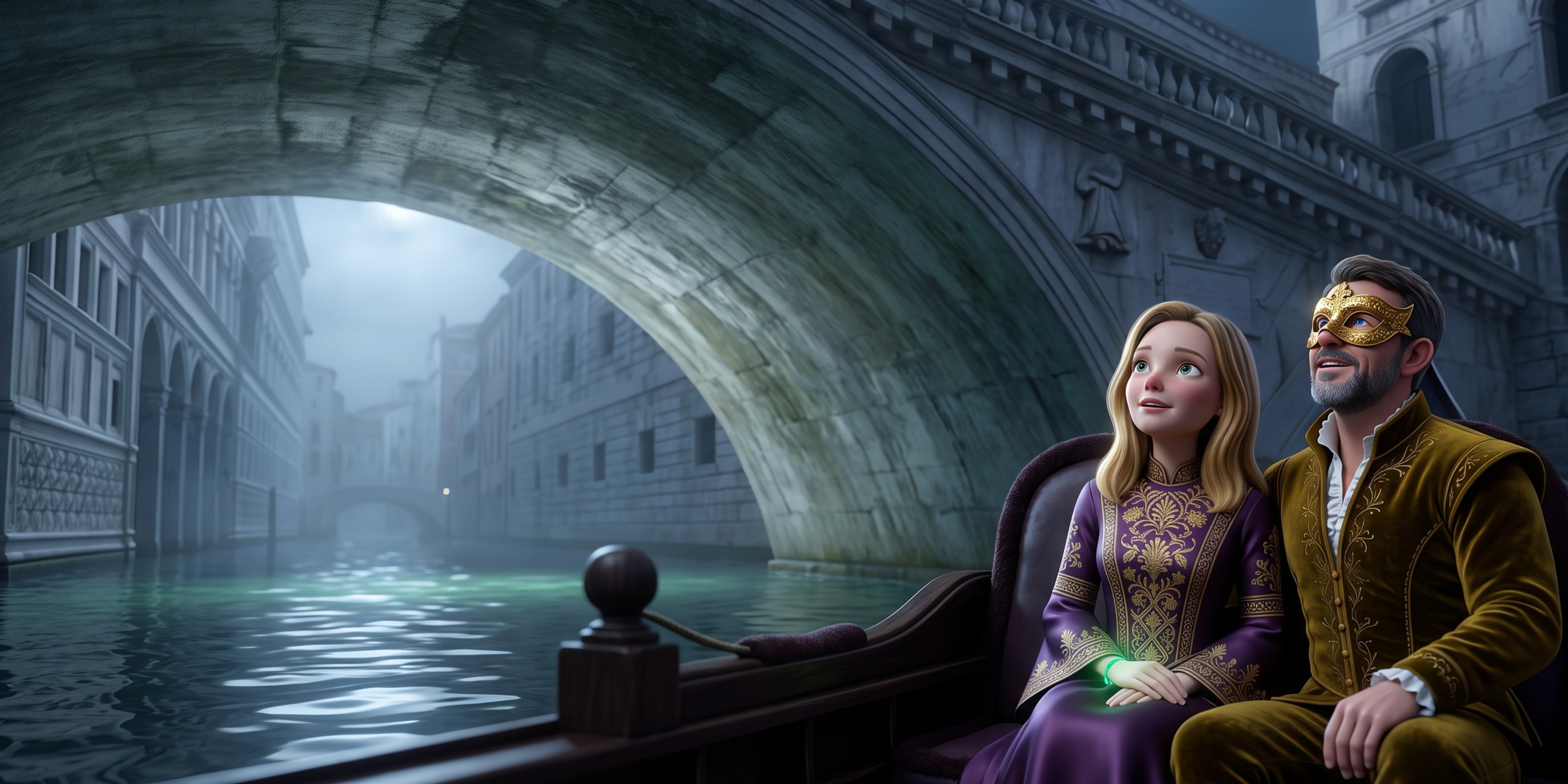
I mean. Look at that gondola scene. The lantern light on the water. The Rialto arch dissolving into moonlit mist. That is a storybook illustration and it has no business being this gorgeous.
Why this delights me
I need to be honest about something: I didn’t make these for my kids. My kids have no interest in a love story set in Renaissance Venice. They want dragons. They want bears on boats. They are five and six and their idea of romance is sharing a popsicle.
I made these for me. And specifically for the version of me that looks at the person who has been beside her for over a decade — through moves and job changes and two pregnancies and a pandemic and the slow, sometimes boring, sometimes beautiful accumulation of shared life — and thinks: what if we’d found each other in every century?
The same person who puts the kids to bed when I’m too tired, who fixes the thing I broke, who brings me coffee without asking — what if he’d been my rock through every age? What does that look like rendered in golden light on a Pompeii wall?
It looks like this. It looks really, really good.
I should also note — and I am delighted by this — that the AI renders Ryan at his actual age. Every wrinkle, every year earned, fully represented. He looks a lot like himself. Meanwhile, I appear to be about twenty-two. No lines. Glowing skin. The green stola fits like it was designed by someone who has never heard of postpartum. I did not ask for this. I did not prompt for this. The AI just… decided. And I am not correcting it. Consider it a feature.
The technology part (briefly)
I want to name what’s actually happening here, because the creative possibilities are wider than I think most people realize.
Enchantably is built for children’s storybooks. That’s the product, that’s the mission, I’m not pivoting. But the engine underneath — the thing that takes a prompt and reference photos and a verse and produces a cinematic illustration with consistent characters across fourteen pages — that engine doesn’t care whether the characters are five or forty. It doesn’t care whether the setting is a bedroom or Pompeii. It just makes beautiful things.
These two books were my way of pushing the boundaries. Could it do historical settings? Could it maintain character likeness across centuries? Could it render architecture, textiles, food, light conditions from specific eras?
The answer to all of those is yes. Emphatically yes. The Pompeii frescoes look like Pompeii frescoes. The Venetian masquerade looks like it was art-directed by someone who’s actually been to Carnevale. The Tuscan cypresses are Tuscan cypresses. And Ryan looks like Ryan in every single one of them — different outfit, different century, same face, same grin, same guy.
The scenes I couldn’t make
Okay, the honest part.
There were scenes I wanted that the AI wouldn’t give me. Nothing remotely scandalous — we’re talking about a married couple in a courtyard. I wanted a scene of Ryan putting his arm around my waist. I wanted a scene of us dancing close at the masquerade. I wanted the kind of tender, domestic intimacy that exists in literally every Pixar movie — Carl and Ellie in Up, the parents in Inside Out, any scene where two adults who love each other are physically near each other in a way that reads as love and not as a business meeting.
The safety filters said no. Repeatedly.
And here’s the thing: I keep those filters high on purpose. Enchantably is a platform for children. It’s a platform for good, for safety, for kindness. I chose these guardrails deliberately, because the alternative — an open system with no boundaries — gets misused in about four seconds, and I will not build something that can be turned into a tool for harm. The filters are a feature, not a bug. They’re part of why I trust my own platform.
The technology can paint the Rialto Bridge by moonlight but won’t let two married people slow-dance. And honestly? I’d rather have that trade-off than the alternative.
So I worked around it. I framed scenes wider. I described gestures rather than contact. I used words like “beside” and “near” instead of “holding” and “embracing.” And you know what? The books are beautiful. Maybe even more beautiful for it. There’s something about two people standing close but not quite touching — the almost, the nearness, the space between them charged with everything unsaid — that is its own kind of romance. The restraint became part of the art.
They’re just a little further apart than real love actually stands. And I’m okay with that. The warmth comes through anyway.
What I’m actually saying
I think we sometimes get so caught up in the utility of things — what’s it for, what problem does it solve, what’s the ROI — that we forget the simplest use case of all: delight. Making something beautiful because it’s fun. Imagining your partner in a linen tunic because it makes you smile. Watching a gondola scene render on your screen at 11pm and feeling your chest get tight because the light on the water is doing something you didn’t expect.
This technology can make you feel things. Not just useful things. Wonderful things.
I made two love stories about my husband set in two cities I’ve never lived in, in two centuries I never experienced, and they both made me cry and I’m going to print them as hardcovers and put them on the shelf next to the kids’ books and nobody can stop me.
If you have a person — a partner, a parent, a friend, a sibling, anyone who has been your constant — imagine them across time. Put them in ancient Rome. Put them in Renaissance Italy. See what the magic shows you.
You might be surprised by what you feel.
Make Your Own Love Story
Upload your photos. Pick a century. Let the magic do the rest. This one’s for you — not the kids.
Create a StoryJoin the Conversation
If you could set your love story in any place and any century, where would it be? And who's the person — partner, parent, best friend — you'd want beside you across time?