
The Magic Is for Us
On Cinderella in a fuzzy box, AI-native children, the Backstreet Boys in a Sphere, and why millennial moms need Enchantably more than the kids do.
My five-year-old pointed at a framed photo on the wall — a photo of himself as a baby, maybe eight months old, sitting in a high chair with sweet potatoes on his face — and asked me if it was real.
Not sarcastically. Not philosophically. He genuinely wanted to know if the image on the wall was a photograph of a thing that happened or something a computer made. He’s five. He’s already living in a world where that’s a reasonable question.
I laughed, and then I didn’t, and then I sat with it for a while.
Because here’s the thing: my children are AI native. I am not. They will grow up in a world where generated images are ambient, where the question “is this real?” is a reflex, where magic on a screen is the default and not the exception. For them, an AI-illustrated storybook starring their stuffed bear is just… a book. Cool, but not astonishing. Not the way it is for me.
For me, it’s astonishing. And I think I need to talk about why, because I don’t think I’m the only one.
Our magic was a fuzzy box
If you were born between roughly 1985 and 1995, your foundational experience of visual magic was a CRT television. A giant, warm, humming box that weighed more than your dog. The picture was soft. The colors bled at the edges. And on that box, Cinderella’s dress transformed in a swirl of sparkles that you watched with your face three inches from the glass because your mother hadn’t told you to move back yet.
That was the magic. Two-dimensional animation on a two-dimensional screen telling a two-dimensional story. Cinderella wanted to go to the ball. She went to the ball. She lost a shoe. A prince found it. The end. No psychological complexity. No earned growth. No nuggets of wisdom you could carry into a boardroom or a hard conversation or a Tuesday at 11pm when you’re wondering if you chose the right life.
We didn’t know we were missing anything. You can’t miss what doesn’t exist yet. But somewhere in the back of our developing brains, we were being told: magic is flat. Magic is pretty but shallow. Magic is for children, and you will outgrow it, and when you do, you will graduate to spreadsheets and mortgage applications and stories that are “realistic,” which is adult code for stories where nothing glows.
We graduated. We outgrew it. We stopped expecting to be astonished.
What we went through instead
I’m not going to list every crisis. You lived them. You know.
But I want to name the cumulative weight of it, because I think millennial women in particular carry a version of it that doesn’t get said out loud often enough. We graduated into a recession. We built careers in systems that kept restructuring underneath us. We had children during a pandemic, or we tried to, or we decided not to for reasons that were never entirely our own. We watched the news cycle accelerate until it felt like living inside a centrifuge. We held jobs and households and aging parents and small humans who needed us to be okay, and we performed okay so convincingly that everyone believed it, including sometimes us.
We are the generation that learned to be competent under fire and then forgot that competence isn’t the same thing as being well.
And now — at 35, 38, 40 — something is shifting. I feel it in myself and I see it in every woman my age I talk to. There’s a recalibration happening. A shedding. A slow, deliberate refusal to keep carrying the things that don’t serve us anymore: the guilt, the performance, the belief that joy is something you earn after the work is done rather than something you build into the architecture of your life.
The Backstreet Boys are in a Sphere
I keep coming back to this image because it captures something I can’t articulate any other way.
The Backstreet Boys — the actual Backstreet Boys, from the posters on our walls, from the discman we shared on the school bus — are performing inside a Sphere. A 360-degree immersive visual experience that didn’t exist when we were thirteen and knew every word to “I Want It That Way.” The music is the same. We are not. The venue is not. The technology is not.
That’s us. We’re having a comeback inside better technology.
We’re the same women who cried over Cinderella’s dress on a fuzzy CRT, except now we’re approaching forty with a decade of hard-won wisdom and a rapidly declining tolerance for anything that wastes our time, and the magic available to us is orders of magnitude more beautiful, more complex, and more meaningful than anything we grew up with.
And here’s the part nobody is saying: we need it more than the kids do.
Why the magic is actually for us
My children will flip through an Enchantably book and see pretty pictures of a dragon. That’s fine. That’s what five-year-olds do.
I flip through the same book and I see hydrangeas rendered in a watercolor style I couldn’t have commissioned for under $500 a page. I see a dragon whose scales have individual texture and whose eyes hold something that looks, if I’m not being too precious about it, like kindness. I see dolphins leaping through bioluminescent water at twilight. I see extraterrestrial creatures on a planet with three moons, and the light is hitting the terrain in a way that suggests someone — something — understood what golden hour looks like on a world that doesn’t exist.
And the stories. The stories are not Cinderella. They have layers. A story about a child learning to share is also about the difference between scarcity and abundance. A story about a first day of school is also about how courage isn’t the absence of fear but evidence that you’ve survived it before. A story about a stuffed bear on an adventure is also about what it means to leave home and come back different.
These are not stories I outgrew. These are stories I finally grew into.
I sit on the couch after the kids are in bed and I open the book I made that day and I look at the illustrations and I read the verses and I feel something I haven’t felt since I was eight years old with my face pressed against a warm glass screen: wonder. Unironic, unproductive, completely useless wonder. The kind that doesn’t optimize anything or advance any goal or check any box. It just feels good.
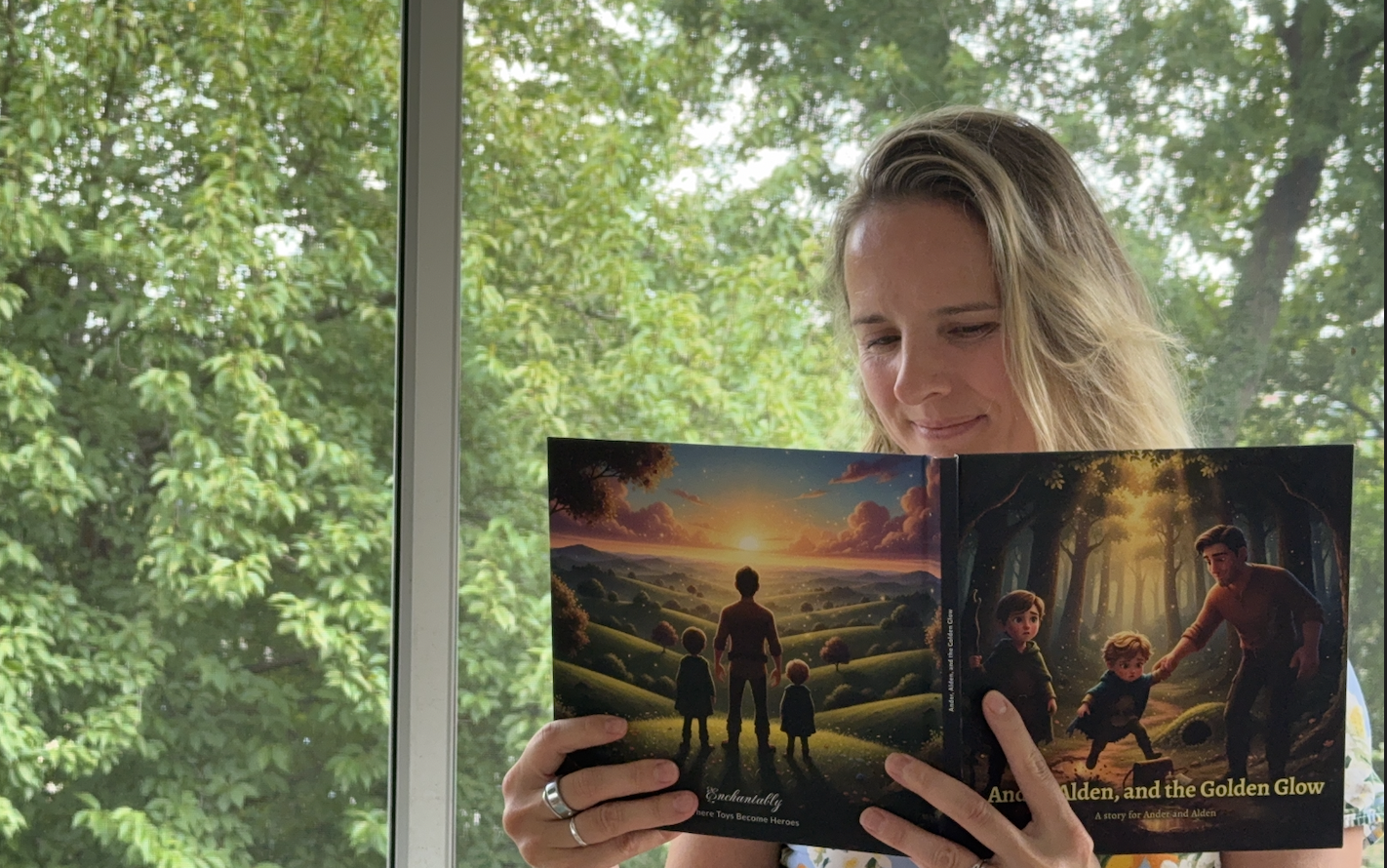
I do it for myself. I’m saying that out loud because I think it needs to be said. I make these books and yes, my children love them, and yes, they’re pedagogically sound, and yes, there are developmental reasons to personalize stories — but the actual honest truth is that I make them because the process of making them fills a well that has been dry for a very long time.
The permission we stopped giving ourselves
Somewhere around 28, most of us stopped letting ourselves be enchanted. We started pre-screening everything for usefulness. Is this productive? Is this a good use of my time? Will this help my career, my children, my household? We became so efficient at filtering out the non-essential that we accidentally filtered out the thing that makes the essential bearable: delight.
I think this is the part the productivity culture got catastrophically wrong, and it landed hardest on women our age. We were told that self-care was a bubble bath and a face mask — a recovery protocol for the machine, not a fundamental human need. Rest was recharging for more output. Joy was a reward, not a practice. And wonder — real wonder, the kind where you look at something beautiful and your chest gets tight and you don’t know why — wasn’t even on the list.
We are approaching what I’ve started calling the “fuck it” age. The age where you look at everything you’re carrying and you start setting things down. Not in defeat. In clarity. The guilt about screen time? Set it down. The performance of having it all together? Set it down. The belief that magic is for children and you have aged out of it? Set. It. Down.
We are not too old for wonder. We are exactly old enough to know what it’s worth.
What I actually see on the screen
When I open Enchantably and I watch an illustration render — when I see my son’s stuffed bear standing at the prow of a ship with a sunrise behind him and the ocean is this impossible shade of turquoise and the light is catching the fur in a way that makes it look alive — I am not thinking about AI. I am not thinking about models or parameters or generation pipelines. I am thinking: this is beautiful, and I made it, and nothing like this existed when I was five.
My son will never know a world without this. He doesn’t need to be astonished by it. He’ll grow up with magic as wallpaper and he’ll find his own astonishment somewhere else, in some technology that doesn’t exist yet, in some medium I can’t imagine.
But I get to be astonished right now. I get to be the generation that watched Cinderella on a box and is now making stories with dragons whose scales have texture. I get to feel the full distance between there and here. And that distance — that span, that journey, that whole accumulation of hard years and hard wisdom — is exactly what makes the magic land.
The kids don’t have the contrast. We do. We know what flat magic looks like because we grew up inside it. We know what stories without wisdom feel like because we consumed hundreds of them. So when a story has depth, when an illustration has soul, when the thing on the screen makes us feel something real — we feel it harder. Not because we’re sentimental. Because we’re experienced.
A confession, and an invitation
I built Enchantably for my children. That’s the origin story and it’s true.
But I keep building it for me. Every new template, every new illustration style, every story about a creature I’ve never seen before — I make it because I want to see what comes out. Because the act of creating something beautiful in a world that has been aggressively unbeautiful for a lot of years is, itself, a kind of medicine. Not the productive kind. The real kind.
So if you’re a millennial mom reading this — or honestly, anyone my age who has spent the last decade being competent and responsible and fine — I want to say something to you directly:
You are allowed to make something beautiful for no reason. You are allowed to look at a picture of a dragon and feel your chest get tight. You are allowed to sit on the couch after bedtime and read a children’s book and cry a little because the verse about courage landed in a place you didn’t know was still tender.
You are allowed to do it for yourself. The kids are fine. They’re AI native. They’ll figure it out.
We’re the ones who need the magic right now. And for the first time in our lives, the magic is actually good enough to deserve us.
Make Something Beautiful Tonight
Pick a story. Watch the illustrations appear. Read the verses out loud or don’t. Nobody’s grading this. It’s just for you.
Explore the StoriesJoin the Conversation
When's the last time you let yourself be astonished by something — not for the kids, not for a purpose, just because it was beautiful? What was it? I want to know.