
The Smoke Outside My Window and the Plan We Didn’t Have
How a hazy sky, a Green Beret’s book, and two sleeping children on the second floor made me build the hardest story on Enchantably.
As I write this, the sky over Virginia is gray. Not the soft gray of an overcast day, but the thick, acrid, wrong-smelling gray of wildfire smoke that has drifted hundreds of miles from Canada, where over 800 fires are burning right now. The air quality alerts are on my phone. The kids can’t play outside.
And all I can think about is: my children don’t know what to do if there’s a fire in our house. Neither do I.
The book that changed how I think about danger
I’ve been reading Prepared by Mike Glover, a former Green Beret who spent twenty years in Special Forces and with the CIA. It’s a book about readiness. Not the bunker-and-MREs kind, but the kind that lives in your nervous system and determines whether you act or freeze when something goes terribly wrong.
One of his first and most striking points is this: in a moment of genuine crisis, a house fire, a car accident, a medical emergency, your brain and body will not react the way you think they will. You imagine yourself as calm, decisive, heroic. But your autonomic nervous system has other plans. Under extreme stress, it activates fight, flight, or freeze, and which one you get is not a conscious choice. It’s the result of whatever your body has rehearsed.
Regular training, repeated exposure to the scenario until the response is automatic, is the only thing that overrides the freeze. Practice builds the neural pathway that lets you act instead of stare.
I read that passage and put the book down and looked at the ceiling, which is the floor of my boys’ bedroom.
The house we live in
We’re renting a house. It’s over a hundred years old. It’s beautiful and full of character and it has gas burners in the kitchen, a wood-burning fireplace in the living room, and wiring that predates most of the safety standards I’d want to bet my children’s lives on. There are surge protectors plugged into outlets I’ve never inspected, power strips daisy-chained behind furniture, and a collection of devices and chargers generating heat in places nobody checks.
The kitchen, with its gas burners and its proximity to small, curious hands that love to experiment, is directly below the bedrooms. So is the fireplace.
My children sleep on the second floor.
If a fire starts downstairs, in the kitchen or the fireplace or a wall somewhere behind the century-old plaster, the staircase is the only way down. And if the staircase is on fire, my children have no way out.
I sat with that for a long minute, and what I felt was dread. Then I started making a list.
Everything I didn’t have
I went through our fire preparedness item by item. It was a short audit, because there was almost nothing to audit:
We have no family meeting spot. If the house caught fire tonight and everyone got out, there’s no agreed-upon place where we’d all go to find each other. The front yard? The neighbor’s porch? I’ve never said it out loud, and neither have my kids.
We have never done a fire drill at home. Not once. I have done hundreds of fire drills in my life: at school, at the office, in corporate buildings where someone in a safety vest herds everyone toward the stairwell and we all roll our eyes and go along with it. And not once have I done one in the building where my children sleep.
I didn’t have a second-story escape plan. My boys’ bedrooms have windows. The windows are on the second floor. And there was nothing between those windows and the ground. No ladder, no rope, no plan.
I didn’t know if my kids knew to stay low. I didn’t know if they knew to feel the door before opening it. I didn’t know if they knew that hiding under the bed, which every instinct in a scared child’s body will tell them to do, is exactly the wrong thing.
I sat down with my husband that night and said, “What do we do if...” and we looked at each other. We didn’t have a plan. We have smoke detectors, yes. We have a fire extinguisher, yes. But we didn’t have a plan: a rehearsed, practiced, the-kids-know-what-to-do-at-2am-when-we-might-not-be-there-to-tell-them plan.
Our two most precious people in the world sleep upstairs, and we were winging it. The honest word for what I felt that night is shame.
The ladder
I bought a foldable escape ladder. The kind that hooks over a windowsill and unfurls down the side of the house. It’s rated for second-story windows. It arrives this week.
How many families have one of these? How many live in two-story houses with children who sleep upstairs and have no way to get them out if the staircase is blocked?
I’m not asking rhetorically. I genuinely didn’t know this was a thing I needed until I sat down and thought through the scenario step by step. Nobody told me. No pediatrician visit, no school orientation, no parenting book ever said: “You need an escape ladder for your children’s bedroom window.”
You bet we’ll be practicing with the kids once it arrives. Because Glover’s point stays with me: you don’t rise to the level of your expectations in a crisis. You fall to the level of your training. A 5-year-old who has never seen a window ladder hooked over a sill will not figure it out while terrified, in the dark, with smoke in the hallway. A 5-year-old who has practiced it four times on a sunny Saturday will remember.
One correction I owe you, because our fire department set me straight after I wrote the first draft of this: the ladder is the plan when a grown-up is in the room. A small child alone upstairs should not be climbing out of a second-story window. Their job, if the door is hot, is simpler: shut it, go to the window, open it, and be seen. We are taping a glow stick beside each boy’s window. Crack it, hold it up, yell. Firefighters look for lights in windows, and they come up to get you. In many cases that is safer than a ladder, and the ladder is still worth having for the nights we are up there with them.
We saw how much seconds matter on screen recently. I won’t spoil it, but if you’ve watched the latest season of Outlander, there’s a fire scene that left me unable to breathe. The whole thing turns on seconds.
The fire drills we dismiss
We’ve been doing fire drills our entire lives, and we treat them as an inconvenience.
The school drill. The office drill. The hotel alarm that goes off at 6am and everyone stands in the parking lot in bathrobes looking annoyed. We roll our eyes. We go through the motions. We’ve done this a thousand times, and it feels pointless.
Except it’s not pointless. It’s the single most effective safety intervention ever designed. When a real fire happens in a school, kids don’t freeze. They walk to the exit in a line. They know where the meeting spot is. They do it automatically, not because they thought about it, but because they’ve rehearsed it so many times their bodies just do it.
That automaticity, the body knowing what to do before the thinking brain can catch up, is exactly what Glover describes as the difference between someone who survives a crisis and someone who doesn’t.
And we do it everywhere except the one building where our children are most likely to encounter a fire: home.
The Enchantably fire safety book
This is the book that has taken me the longest to build. I’ve spent more hours on this arc than any other story on the platform, and I still don’t have it quite right. The pacing isn’t perfect. Some of the illustrations need another pass. There’s a scene transition that feels rushed.
I’m publishing it anyway.
Because if this book saves one child, just one who remembers “LOW AND GO” at 2am because they read it a hundred times at bedtime, this entire venture is worth it. The late nights, the debugging sessions, the 429 errors, the weeks I almost quit: all of it, worth it for one kid who crawls to the door instead of hiding under the bed.
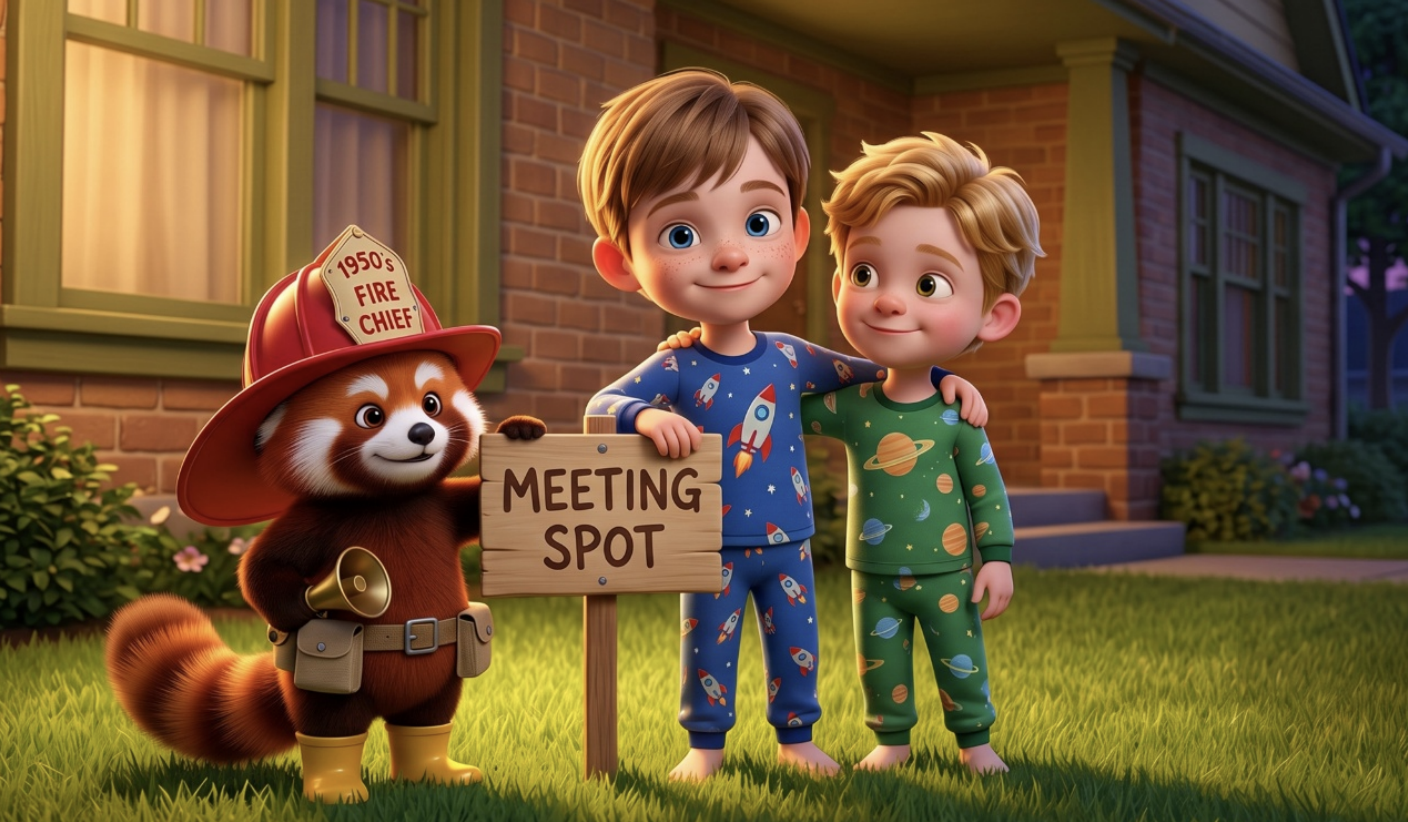
The story follows two brothers who wake up to a smoke alarm. The room is filling with smoke. Every instinct tells them to hide: under the bed, in the closet, the small dark spaces where scared children go. But they’ve practiced. They know the plan. And a little panda named Sparky, in boots and a helmet, appears to walk them through it.
The rules are specific, because vague safety rules are useless to a terrified child:
LOW AND GO. Smoke rises. The breathable air is near the floor. Drop down and crawl: to the door, down the hallway, out of the house. The story shows this, names it, repeats it until it sticks.
Don’t hide, go outside. Under the bed feels safe. The closet feels safe. They’re not. The story addresses this directly (“under the bed is not the space, a closet is no hiding place”) because the instinct to hide is so strong in children that it has to be specifically overridden.
Feel the door with the back of your hand. Before you open any door, check if it’s hot. If it is, don’t open it; there’s fire on the other side. Use your second way out. This is a detail most adults don’t know, let alone children.
Two ways out of every room. The door is one. The window is two. The story teaches children to identify both exits in any room they’re in, not just at home, but at a hotel, at a friend’s house, at school. And it is honest about what the window means on an upper floor: not a place to climb out alone, but the place to be seen. The glow stick by the window is in the book now, because it is by our windows now.
Stop, drop, and roll. If your clothes catch fire, don’t run; running feeds the flames. Stop where you are, drop to the ground, cover your face, and roll. Sparky demonstrates this with a bit of slapstick that makes my boys laugh, which is exactly the point. They remember the rule because they remember the laugh.
Once you’re out, stay out. No going back for toys. No going back for pets. The firefighters are coming. Stay at the meeting spot. This one is hard for kids, and hard for adults, but the story is firm about it.
Your family’s meeting spot is in the story. When you create the book on Enchantably, you enter your actual meeting spot: the big oak tree, the neighbor’s porch, the mailbox at the end of the driveway. Your specific spot, built into the narrative, so your child rehearses going to your place, not a generic one.
And you can upload a photo of your child’s actual bedroom and hallway for more tailored illustrations. The AI renders an imperfect but recognizable version of their real space: their door, their hallway, their way out. A child who sees their actual bedroom in the story connects to the scenario differently than a child looking at a generic room. It stops being abstract and becomes their plan.
The drill we’re starting this month
The book isn’t enough. I know that. Glover’s point is clear: reading about it isn’t the same as doing it. The body has to practice.
So we’re starting monthly fire drills. At home. For real. The kind where the smoke alarm goes off (we’ll warn them the first time) and everyone gets out as fast as they can and meets at the spot. We’re going to time it. The boys in the poem get it down to twelve seconds. I want to know our number.
When the escape ladder arrives, we’ll practice with that too. On a sunny Saturday, with no urgency, from a first-floor window with me right beside them, which is the only way children are supposed to practice one. And we’ll practice the glow stick: crack it, hold it up, yell. We’ll do it until it’s boring, until they roll their eyes and their bodies just know.
Neither one is enough alone. The book gives them the language, the story, the rules they can sing. The drill gives their bodies the memory. Together, they build the kind of preparedness that Glover describes: not fearful readiness, but calm, rehearsed, automatic response.
Why I can’t wait until it’s perfect
I said the book isn’t quite right yet. Some of the scene transitions need work. An illustration or two needs regeneration. The pacing in the middle could be tighter.
I thought about waiting. Polishing it. Getting it exactly right before putting it out there.
And then I looked at the smoke outside my window. Over 800 fires burning in Canada right now. Air quality alerts in Washington, D.C., twenty minutes from my house. My kids staying inside because the air isn’t safe to breathe. Fire doesn’t wait for you to be ready.
The book is live. It’s not perfect. And I’d rather a child have an imperfect fire safety story tonight than a perfect one in three months.
Read the full story
Here’s Low and Go, the fire safety book I built for my boys. Flip through it:
Every book is unique and features your child. This is just one example of what a finished book looks like.
The song they sing
Every Safety Magic story comes with a generated song, a Lyria-composed melody that weaves the safety rules into something singable. The idea is simple: a rule set to music sticks differently than a rule on a page. It moves from the thinking brain to the body and becomes automatic.
My boys hum this one. Not performatively, just absently, the way you hum a song that’s become part of your day: in the car, in the bath, walking past the smoke detector in the hallway. The rules travel with the melody: low and go, don’t hide go outside, feel the door, two ways out, stay outside.
That’s the goal: a child who doesn’t have to think about the rules because they’re already singing them.
Here’s the full song from the fire safety story. Press play:
Explore the Fire Safety Story on Safety Magic
Fire safety is one of eight Safety Magic scenarios on Enchantably: personalized safety stories that teach real rules through real adventures starring your child, with your meeting spot, your hallway, and your child’s name built into their plan.
Explore Safety MagicJoin the Conversation
When’s the last time you did a fire drill at home? Do your kids know the meeting spot? Do you have a second-story escape plan? And be honest — do you know where your nearest fire extinguisher is right now, without getting up to check? I didn’t. The conversation starts here.