
The Night We Stopped Saying Calm Down
On bedtime chaos, proprioceptive input, and six books that let my boys be loud before they went quiet.

7:47pm. Both boys have been in pajamas for twelve minutes. In that time, Ander has done a full lap climbing and jumping off every bed in our three bedrooms upstairs, Alden has kicked the wall fourteen times from a horizontal position on his bed, and someone (I genuinely do not know which one) has thrown a sock at the ceiling fan.
I am standing in the doorway holding two cups of water and a rapidly diminishing reserve of composure, and I am about to say the thing. The thing every parent says. The thing I have said four hundred times and that has worked exactly zero of them.
Calm down.
Except tonight I don’t say it. Tonight I say: “Okay. Let’s catch the wiggles.”
Both boys are on their feet, shaking their hands, within four seconds.
What “calm down” actually communicates
For years, the entire duration of my older son’s life, I treated bedtime restlessness as a behavior problem. Specifically, as a compliance problem. The instruction was clear: lie down, close your eyes, go to sleep. The fact that my children could not do this seemed, on some level I am not proud of, like a choice they were making. A defiant, sock-throwing choice.
Brené Brown talks about the stories we tell ourselves, the narratives we construct to explain other people’s behavior when we don’t have all the information. My story was: they are not listening. The actual story was: their bodies were not finished.
Telling a five-year-old to calm down at bedtime is like telling someone mid-sneeze to stop sneezing. The instruction requires the exact skill that is currently offline.
The more I said it, the less it worked, and the less it worked, the more frustrated I got, and the more frustrated I got, the more shame crept into the room. Not theirs. Mine. The quiet, corrosive kind that sounds like: other parents have figured this out. Why is this still so hard?
What is actually happening in their bodies
Here is what I wish someone had told me three years ago, before I spent eight hundred bedtimes saying the wrong thing:
A child who is bouncing at 7:45pm is not dysregulated. They are unfinished. Their motor system has energy that was never fully spent, and it is doing what a motor system does with unspent energy: it moves. The kicking, the flipping, the one-more-question loop, the inexplicable need to get up for water four times. None of it is defiance. It is a body that has not yet received the signal that the day is over.
And with boys in particular, I am going to say this plainly because nobody said it to me: the baseline motor activity is higher. Not because boys are “wild” or “harder”. Because testosterone during early development produces higher baseline muscle activation and a wider range of gross motor output. It is a physiological fact, not a character flaw. My sons are not more restless than other children because they are difficult. They are more restless because they are boys, specifically boys between four and seven, and their bodies are doing exactly what those bodies are supposed to do.
The issue was never the energy. The issue was that I had no plan for where it was supposed to go.
What occupational therapists already know
Adam Grant writes about how we tend to fixate on the wrong variable, the symptom we can see rather than the mechanism underneath. I was fixated on the wiggling. The wiggling was the symptom. The mechanism was proprioceptive input.
Proprioception is your body’s sense of where it is in space. Pushing, pulling, carrying, squeezing. Anything where your muscles work against resistance. Occupational therapists call it “heavy work,” and they have been prescribing it before bedtime for decades, because it does something no amount of “calm down” can do: it organizes the nervous system. It tells the body you have done enough today.
OTs have been recommending this for decades. Big movement first, then heavy work, then slow stretching, then deep breathing. The body spends what it has, and eventually it stops sending “we are not done” signals to the brain. And the counterintuitive part is that the movement has to come first. You cannot skip to the calm part. The body has to spend what it has before it can settle.
I read this and thought: occupational therapists have known this for thirty years, and parents are still standing in doorways saying “lie still.” The information exists. The translation doesn’t. Nobody has given parents a bedtime routine that IS the method, that does the spending and the settling in the right order, inside a story their child actually wants to hear.
So I built six.
What the books actually do
Every Bedtime Magic book runs the same energy curve, and the curve is the method. You are not reading a story about going to sleep. You are reading a story that puts your child to sleep, one page at a time, by giving their body something real to do on every single page.
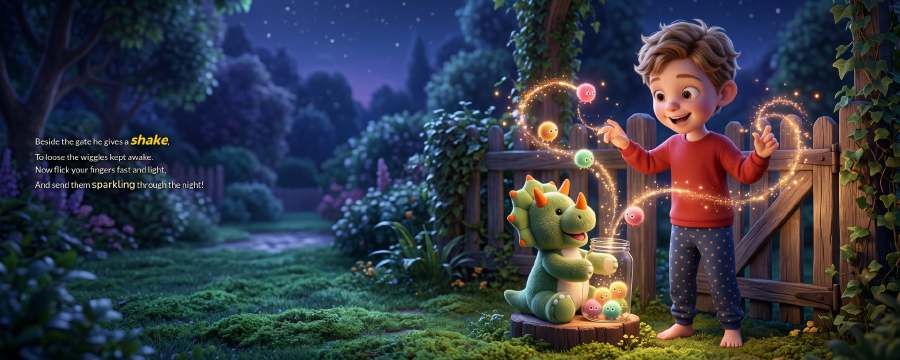
The first few pages are big and fast. Stomp. Shake. Jump. Throw. These are not metaphors. Your child does the move, in bed or standing beside it, while you read the verse. The book gives them permission to be loud in a way that bedtime usually forbids. And that permission, the sheer relief of someone saying yes, move instead of stop moving, is half the medicine.
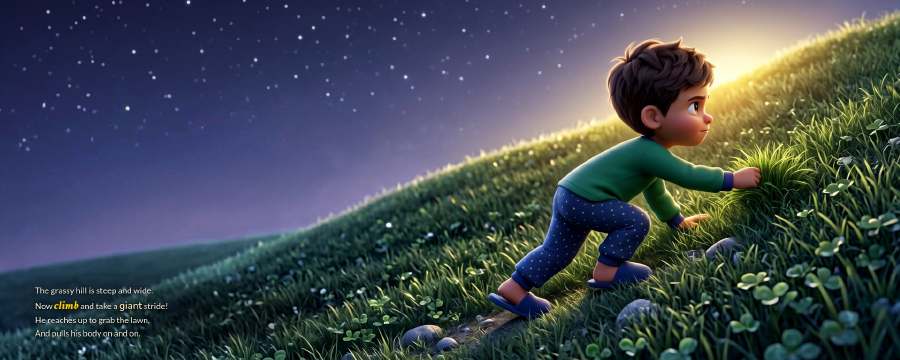
Then the moves turn heavy. Push against your palms. Carry something with both arms. Pull yourself up a hill. This is the heavy work, the proprioceptive input, the part the occupational therapists would recognize. On these pages the verse slows down too. Longer vowels, fewer exclamation marks, the rhythm loosening like a fist unclenching.
Then the stretches. Then one long breath out. Then stillness.
And the curve is not just in the movements. It is in three things at once: the verse starts bouncy and fast, then gets slower and softer until the last page is a whisper. The illustrations start in warm gold and get cooler page by page (lavender, silver, deep night blue) so the child’s body follows the light without knowing it. And the movement word on each page is set big and dramatic while the book is loud. Once the story goes quiet, nothing is shouting anymore.
By the last page, they are heavy. I have watched this happen with my own two children, on my own couch, more nights than I can count. Not asleep, usually, but heavy. The legs are long and still. The breathing has changed. The kicking-the-wall energy is gone, not because anyone told it to leave, but because it was spent, properly, in the right order, and the body got what it needed.
The book never says calm down. It never says lie still. It never says stop wiggling. It makes them do the thing that makes the wiggling unnecessary.
The six books
Each one runs the same energy curve but wraps it in a different world. Because a five-year-old who shook out wiggles last night needs a different reason to shake tonight.
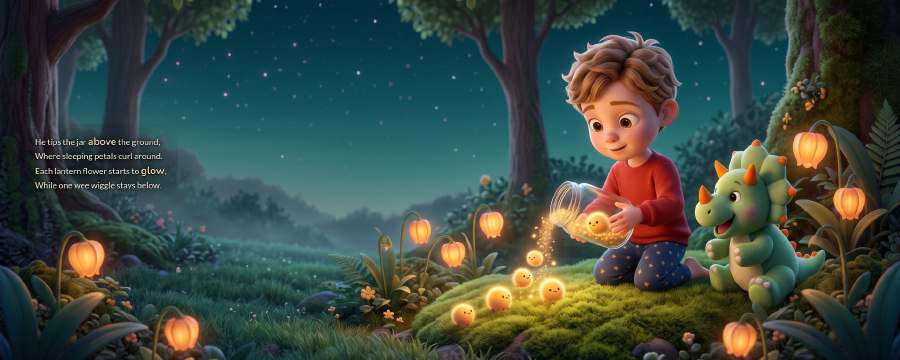
Catch the Wiggles. The wiggles are real: tiny glowing creatures living in your child’s fingers and toes and knees, and they need to get home. Your child shakes them out, one body part at a time, while their stuffed animal catches them in a jar. The stubborn one in the tummy won’t shake out no matter how hard they try. It only floats free when your child goes completely still and breathes out slow. This is the one we read most.
The Storm Who Got Sleepy. Your child IS the storm. They stomp like thunder, blow like wind, drum their fingers like rain. Then the storm gets tired. The thunder yawns, the rain softens to a drizzle, the wind becomes a whisper, and the child’s body follows the weather down. Alden’s favorite. He has informed me that his thunder is louder than real thunder, which I believe.
Help the Moon Up. The moon is stuck below the hills and needs help climbing. Your child pushes, digs, pulls, carries. All heavy work, all in bed. Once the moon is up and shining, the world goes quiet, and so does your child. Pure proprioceptive input dressed as an adventure.
The Night Conductor. Your child conducts an orchestra of night sounds: the crickets, the owl, the wind in the leaves. Fast at first, then slower, then slower, until the last song is just a heartbeat.
Bubble Rings for a Sleepy Dragon. A small dragon who cannot sleep comes to your child’s window. Your child teaches it to breathe. Not fire, but slow, shimmering bubble rings that float up and drift off to the stars. By the last page both the dragon and your child are breathing at the same pace. Breathing exercises that a four-year-old will actually do, because there is a dragon.
Zoomies to Snoozies. This one requires a pet. Your child copies their dog’s own bedtime routine: the zoomies, the shake, the circles, the flop, the curl, the sigh. If your child has a dog and that dog does the 8pm zoomies (and if you have a dog, you know exactly what I mean) this book is the one.
The part about boys
There is a gap in how we talk about boys at bedtime. I think it costs us.
The parenting conversation about bedtime is dominated by strategies designed for stillness: dim the lights, lower the voice, read a quiet story, maybe do a guided meditation if your child will tolerate it. These strategies work beautifully for a child whose body is already close to still. For a child whose body is not close to still, and statistically, more often, that child is a boy, these strategies fail on contact. And the failure feels personal.
Brown would call this a vulnerability gap. The parent (usually the mother, since bedtime still falls disproportionately on mothers) interprets the failure as evidence that she is doing something wrong. That she hasn’t found the right routine. That other kids lie still when asked. That her son is “more difficult” than he should be. And the shame of that story makes it harder to do the one thing that would actually help, which is to stop trying to suppress the energy and start spending it.
The calm-down books start at the destination. My boys needed a book that started where they actually were.
I tried every calm-down bedtime book on the shelf. The ones with the deep breaths and the body scans and the whispered affirmations. They are lovely. They work beautifully for some kids. They did not work for mine. Because my boys at eight o’clock are not in a state where they can take a deep breath. They are in a state where they need to stomp seventeen times and push a moon up a hill and then take a deep breath.
What changed at our house
We have been reading these books for about two months now. I will be precise about what changed, because the internet is full of parents claiming miracles and I am not one of them.
The boys still have energy at bedtime. They will always have energy at bedtime. They are five and seven and they run at a metabolic rate that I, at forty, find personally offensive. That has not changed.
What changed is that the energy has somewhere to go. “Catch the wiggles” is a sentence that both of my children understand and respond to, because they have done it dozens of times and it is fun. Ander asks for The Storm. Alden asks for the dragon. They shake, stomp, push, carry, breathe, in bed, in pajamas, in the ten minutes between toothbrushing and lights out. And by the last page their bodies are different. Heavier. Slower. Done.
I don’t say calm down anymore. Not because I read an article about it or because a therapist told me to stop. Because I don’t need to. The book does the thing I was trying to do with words, except it does it with the body, which is where the problem actually lived.
There is a verse in Catch the Wiggles, the page where the stubborn tummy-wiggle finally floats free - my son goes still when he hears it. Actually still. Not told-to-be-still. Still because his body arrived there on its own, through sixteen pages of shaking and carrying and breathing, and by the time the tummy-wiggle floats out, there is genuinely nothing left to wiggle.
That is not a story about going to sleep. That is a method for going to sleep, with a plot and illustrations and a stuffed dinosaur who catches glowing creatures in a jar. And it works better than anything I have tried in six years of parenting, including melatonin gummies, white noise machines, and the time I desperately tried a “bedtime yoga” YouTube video that lasted ninety seconds before someone kicked someone else in the face.
Ten minutes. Sixteen pages. No one said calm down. And if someone throws a sock at the ceiling fan on page three, that is fine. The wiggles are not done yet. You have thirteen pages to go.
See the first pages free
Pick a bedtime book, upload one photo, and see your kids' custom opening pages, the big moves, the illustrated hero, the verse, before you pay for anything.
Explore Bedtime Magic and See These Sample BooksJoin the Conversation
What does bedtime actually look like at your house? Not the Instagram version — the real one. And what's the thing that finally works, when it works? I'd love to hear.